One AI-native operating layer for people, agents and systems.
AI OS connects goals, context, models, workflows and controls into one execution environment - so a firm runs on software it owns instead of a shelf of disconnected tools. Every build we do runs on it, and it deploys in your cloud, your on-prem or a sovereign EU region.
Complete infrastructure to run an AI-native firm.
Six layers, built once and reused by every workflow you put on them. Governance is not a layer on top - it runs through all of them.
What your people and your clients actually touch: workspaces, review queues, approval screens, the CLI your engineers live in.
Long-running processes with agents that do the work, escalate on judgment calls and stop at the gates you set.
Your documents, systems and decisions in one indexed layer, read under one set of permissions - so nothing is re-entered between tools.
Routed per task, never hard-wired. Frontier, open-weight or local models swap in without breaking anything built on top.
Your existing systems - ERP, CRM, DMS, ledgers, e-mail - connected once, with the audit trail attached.
Every run measured against the requirement that produced it: accuracy, cost, latency, drift, and who approved what.
Who and what may reach which data and take which action - enforced identically for a person, an agent and an application, with a full audit trail on every decision.
From domain expertise to production. With receipts.
You describe the business in plain language. The factory turns it into specs, agents, code and tests - and leaves a trail you can audit at every step.
Living documentation
A knowledge graph of the venture that never drifts from what is actually running.
Full visibility
Every decision, change and rationale is recorded - including the ones an agent made.
Humans in the loop
Your experts co-author specs and approve gates. The AI proposes; the operator decides.
Context flows both ways
Feedback from production loops back into requirements instead of dying in a ticket.
Model and IDE of choice
No lock-in to a frontier lab. Swap models - including local ones - without losing context.
Greenfield and legacy
New ventures from zero, or an existing operation modernised system by system.
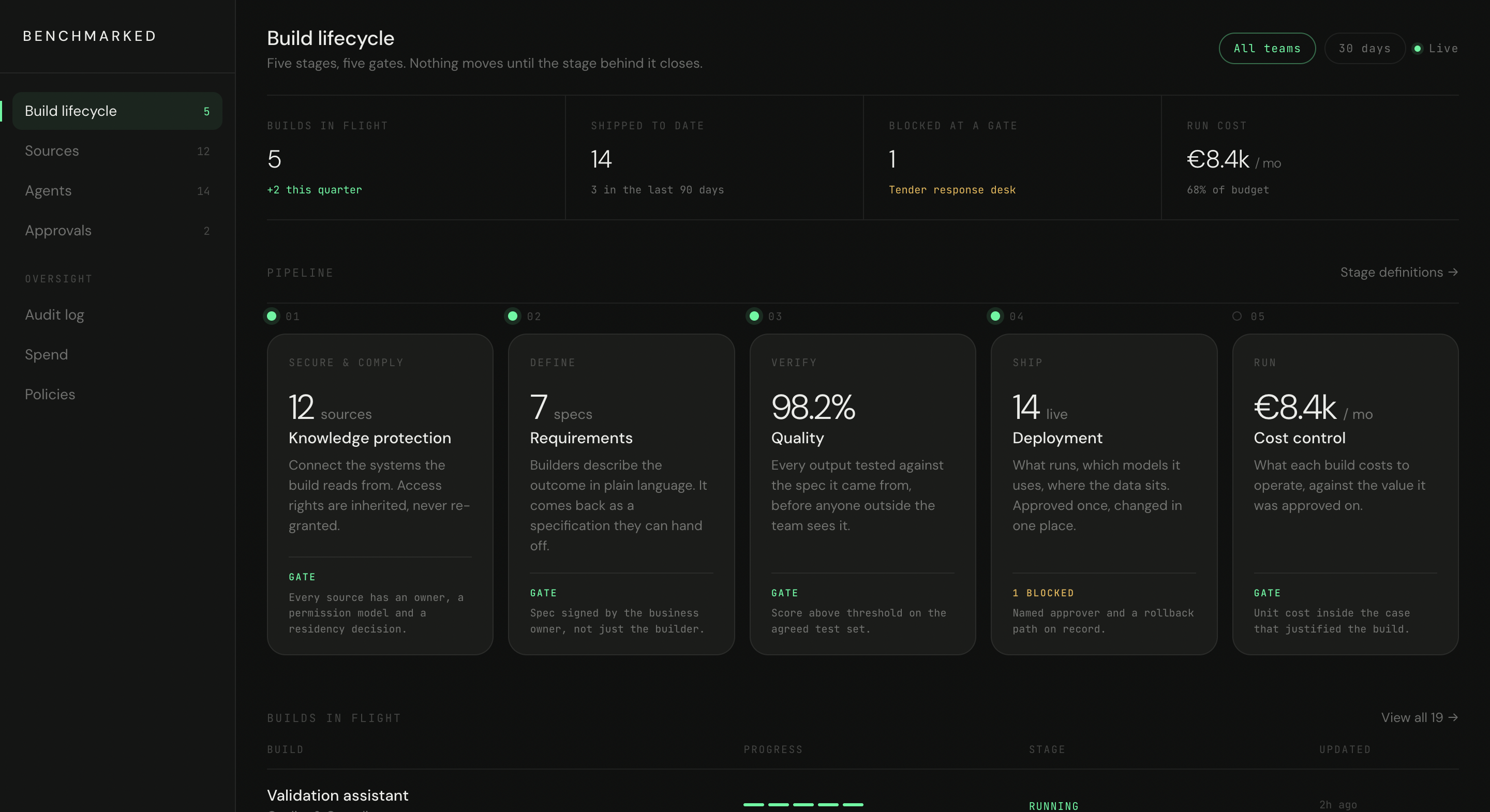
Every build runs through the same five gates.
Builders always know the next step; leaders always know where every build stands. Nothing moves forward until the stage behind it closes.
Key SDLC modules
The control plane is assembled from these modules. Every venture gets all of them on day one - and owns them when we hand over.
Knowledge protection
Your domain know-how, data and prompts stay inside your boundary - encrypted, access-controlled and never used to train anyone else's model. The venture's alpha is treated as the asset it is.
Requirements
Fast code is useless without clear direction. Domain experts and agents co-author, debate and refine requirements in one workspace, in language the business can actually read.
Quality
Every feature is validated against the requirement that created it. Tests, reviews and evals run before anything ships, so correctness is proven rather than promised.
Deployment
One path to production across environments - your cloud, your on-prem, or a sovereign EU region. Releases are reproducible and reversible, with no hidden vendor runtime.
Work order
Product intent and architecture become structured work orders with the full context an agent needs to generate correct, aligned code - and a human owner for every one.
Cost control
Token, compute and infrastructure spend metered per venture, per agent, per model. Swap to cheaper or local models when the work allows and watch unit economics flatten.
Loops
Feedback from production, support and operations comes back in as structured work instead of dying in a ticket. The system learns from what actually happened.
Four surfaces, one platform underneath.
Everything a firm needs to put AI into real operations - and none of it bought separately, integrated separately, or governed separately.
Requirements, blueprints, work orders and gates. The place where intent becomes shipped software with an owner and a timestamp on every step.
Long-running agents that handle customer requests, staff work and back-office execution - escalating to a person exactly where judgment belongs.
AI-native applications that take over the business systems your firm outgrew, built on your data and your process instead of a vendor roadmap.
One place where models, tools, data access, cost and policy are controlled - for every agent and every application in the firm.
The advantage of a unified, open layer.
Running a firm on one operating layer turns goals, context, models, workflows and controls into a single execution environment instead of five procurement decisions.
Nothing you build is locked to a model. Each task routes to whichever model fits, and a new one drops in without rewriting what already works.
Permissions, integrations and audit setup are normally rebuilt for every AI project. Here they are built once and reused, so use case three costs a fraction of use case one.
Siloed tools force work to be re-entered between them. Everything reads the same data under one permission model, so work continues instead of restarting.
More agents means more decisions taken while nobody is watching. One place governs data, access, quality and cost - so they scale together.
Every decision that runs through the layer records how your firm actually operates. That record is data no competitor can buy, and the system keeps learning from it.
Built for regulated work. From deployment to data protection to compliance.
Your cloud, your on-prem, or a sovereign EU region - across AWS, Azure and GCP, with your keys and your network boundaries.
Prompt-injection protection, agent guardrails, scoped tool access through a governed gateway, and third-party penetration testing.
Zero retention with model providers, automatic PII redaction, encryption at rest and in transit. Nothing you give us trains a model.
ISO 27001 and GDPR aligned, EU AI Act ready, with human-approved gates and an audit trail on every agent action.
If you don’t want to do this alone, this is the team we bring in to execute your vision.
Extremely lean by design - the same people who design the venture also build and ship it, embedded with your team rather than billing from a bench.
The people who run the ventures.
“We came in with twenty years of domain knowledge and no engineering team. Ten weeks later we were running our own software - not renting someone else's.”
“The audit trail is what got it past our risk committee. Every agent action has an owner, a rationale and a timestamp.”
“Our per-user cost stopped climbing the month we moved the model layer in-house. That single change made the unit economics work.”
“It replaced a six-month spec phase with a week of structured argument. The specs are better because everyone could actually read them.”
Every venture inherits the same stack.
Six layers, built once, reused across every company the factory produces.